
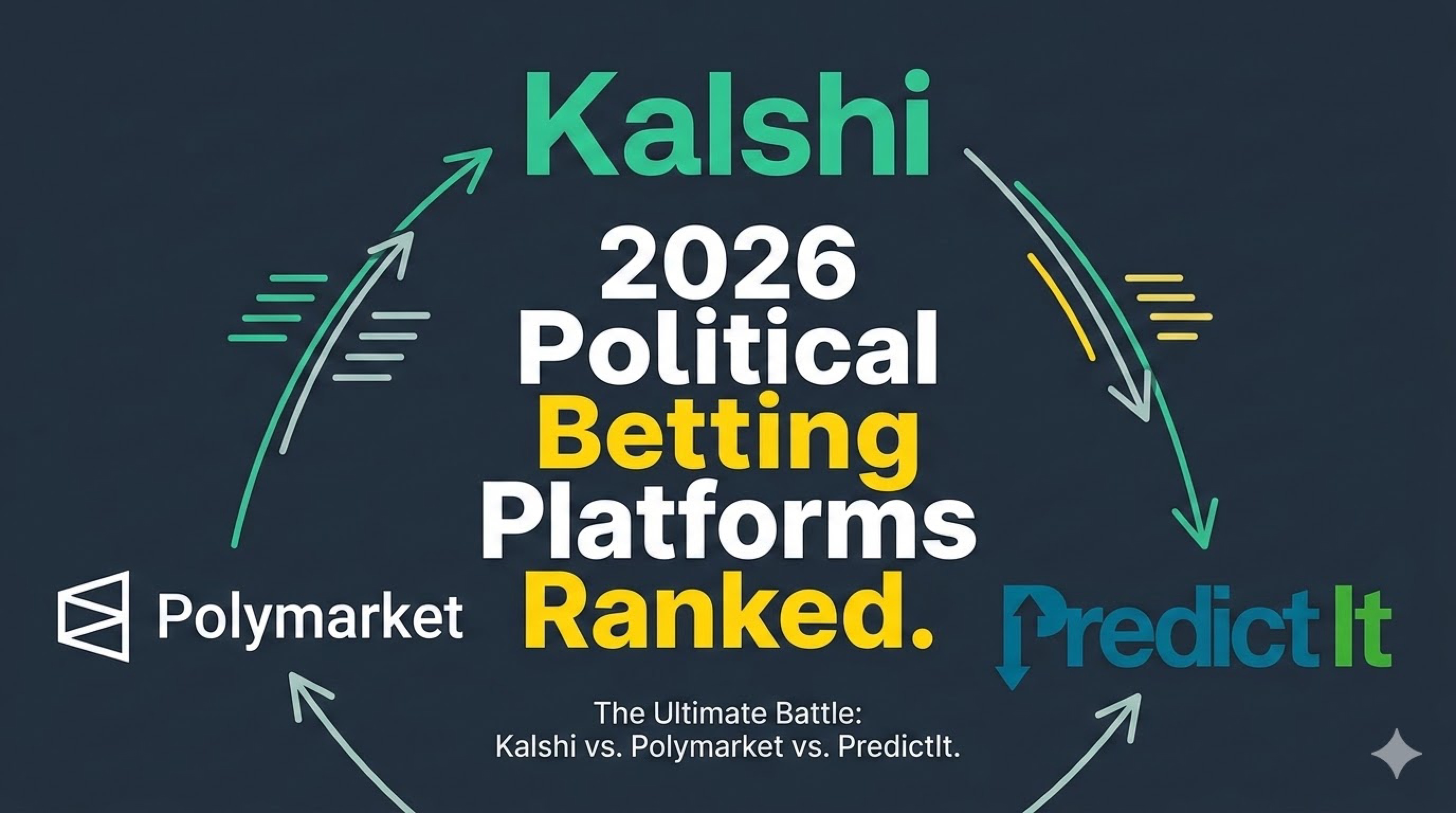
7 Best Political Betting Sites (2026): Kalshi vs Polymarket
We analyzed liquidity, fees, and legality for the 2026 midterms. See who wins the fee war between Kalshi, Polymarket, and PredictIt. Updated March 2026.
7 Best Political Betting Sites (2026): Kalshi vs Polymarket
Political betting has gone mainstream. In 2024, prediction markets proved they could outperform polls on election night. In 2025, every major platform secured full CFTC regulation. And now, heading into the 2026 midterms, Kalshi and Polymarket are posting a combined $17.9 billion in monthly volume — with political contracts driving some of the biggest trading days the industry has ever seen.
Whether you're a serious trader moving size, a crypto native looking for the lowest fees, or a casual political junkie making your first trade, the platform you choose matters. Fees, liquidity, market selection, and state availability all vary — and the differences can directly affect your returns.
We tested Kalshi, Polymarket, and PredictIt side by side across fees, regulation, liquidity, market depth, and user experience. Here's how they stack up.
Quick Comparison
TL;DR: Kalshi is the best site for high-limit, regulated US trading. Polymarket offers competitive fees with free maker orders and the deepest liquidity. PredictIt remains best for casual, low-stakes retail traders.
Fees, Regulation & Access
| Platform | Regulation | Trading Fees | US Access |
|---|---|---|---|
| Kalshi | Fully CFTC-regulated (DCM) | Formula-based, ~1–2¢ per contract | 40–45 states |
| Polymarket | CFTC-regulated (Amended Order of Designation) | Category-based, ~1% on politics | Invite-only rollout; state restrictions |
| PredictIt | Fully CFTC-regulated (DCM + DCO) | 10% profit fee + 5% withdrawal | Nationwide |
| Robinhood (via Kalshi) | Regulated (Kalshi infrastructure) | Same as Kalshi | Same as Kalshi |
| Crypto.com | CFTC-regulated | Varies by market | Available |
| Sportsbooks | Varies by region | Vig/juice | Varies |
Liquidity, Limits & Depth
| Platform | Liquidity | Trading Limits | Best For |
|---|---|---|---|
| Kalshi | High | No per-contract cap | Large traders, compliance-first users |
| Polymarket | Very High ($3.3B+ in 2024) | No cap | Crypto users, fee-sensitive traders |
| PredictIt | Moderate | $3,500 per contract | Casual traders, politics-only focus |
| Robinhood (via Kalshi) | High | Same as Kalshi | Existing Robinhood users |
| Crypto.com | Growing | Varies | Crypto holders, multi-asset traders |
| Sportsbooks | Low | Varies | Hobbyist bettors |
Want to see how prices differ across these platforms right now? Compare live odds with Prediction Hunt's market comparison tool to find the best price before you trade.
How We Ranked These Platforms
We evaluated each platform on five criteria: regulatory status (is it CFTC-regulated?), fee structure (what do you actually pay per trade?), liquidity (can you enter and exit positions without slippage?), political market depth (how many midterm, presidential, and policy markets are available?), and user experience (how easy is it to fund your account, place a trade, and withdraw?).
We also cross-referenced prices on identical political contracts across platforms. The same question — say, "Which party controls the Senate after 2026?" — can trade at meaningfully different prices on Kalshi vs. Polymarket. Those price gaps are why using a comparison tool matters.
Best Overall: Kalshi
Kalshi is the platform that forced the door open for legal political betting in the U.S. In September 2024, a federal judge ruled that Kalshi's election contracts are commodity derivatives — not gaming — rejecting the CFTC's attempt to block them. The D.C. Circuit denied an emergency stay, and Kalshi went live with election markets 32 days before the 2024 presidential election. The CFTC dropped its appeal entirely in May 2025.
That court victory didn't just benefit Kalshi. It set the legal precedent that allowed Polymarket and PredictIt to secure their own CFTC approvals later that year.
Fees & Costs
Kalshi uses a formula-based fee structure rather than a flat rate. The formula is:
Fee = round_up(0.07 × contracts × price × (1 − price))
In practice, this means fees peak on 50-cent contracts (where uncertainty is highest) and drop toward zero on contracts near 1¢ or 99¢. For most trades, you're paying roughly 1–2 cents per contract. There are no settlement fees.
For deposits and withdrawals, ACH bank transfers and wire transfers are free. Debit card and Google Pay transactions carry a 2% processing fee. Crypto deposits are generally free, though third-party processors may charge their own fees.
Regulation & Trust
Kalshi is a fully registered Designated Contract Market (DCM) under the CFTC. It's available in roughly 40–45 states, though state-level legal challenges are ongoing — 19 or more state actions had been filed against Kalshi by January 2026, primarily around sports-related contracts. Political contracts have faced less state-level resistance.
Market Coverage for 2026
Kalshi has deep liquidity on midterm races, including Senate and House control, individual swing-state races, and policy outcomes like government shutdowns, Fed rate decisions, and tariff markets. The 2028 presidential market already has over $10.8 million in trading volume on Kalshi alone. The platform also generated roughly $13 million of the $17 million in total volume around Trump's 2026 State of the Union address.
Who It's Best For
Serious traders who want the deepest U.S.-regulated political market with institutional-grade infrastructure. If you're moving large positions and want ACH transfers with no withdrawal fees, Kalshi is built for you. Also the best choice for users who want to access prediction markets through Robinhood or PrizePicks, since both integrate with Kalshi's contract infrastructure.
Best for Liquidity & Low Fees: Polymarket
Polymarket is the world's largest prediction market by volume. It generated $3.3 billion in trading volume on the 2024 presidential race alone, and by October 2025, it was facilitating over $3 billion in monthly trades globally. In late 2025, Intercontinental Exchange (ICE) invested up to $2 billion in Polymarket, valuing the company at roughly $8–9 billion.
For most of its existence, Polymarket was off-limits to U.S. users. That changed in late 2025.
The U.S. Relaunch
Polymarket's path back to the U.S. involved several key steps. In July 2025, the DOJ and CFTC dropped their investigations into whether the platform had continued serving U.S. users despite a 2022 ban. That same month, Polymarket acquired QCX, a CFTC-licensed derivatives exchange, for $112 million. In November 2025, the CFTC granted Polymarket an Amended Order of Designation, and the platform relaunched for U.S. users on December 2, 2025.
The U.S. version of Polymarket operates differently from the global platform. American users trade through futures commission merchants (FCMs) and traditional brokerage channels with full KYC requirements — closer to a regulated financial exchange than the crypto-wallet experience available internationally. Access is still rolling out on an invite basis, and the set of available markets is more limited than the global version.
It's also worth noting that some states have pushed back. Nevada's Gaming Control Board filed a civil complaint against Polymarket in January 2026, and Massachusetts courts have issued preliminary injunctions against similar platforms. Availability can vary depending on where you live.
Fees & Costs
Polymarket recently introduced category-based taker fees across all markets. The fee uses the formula Taker Fee = Multiplier × Price × (1 − Price), where the multiplier varies by market category. For politics markets, the multiplier is 4% (~1.0% peak fee at 50¢). Crypto markets are 7.2% (~1.8% peak). Sports markets are 3% (~0.8% peak). Geopolitical markets remain fee-exempt. Maker orders (limit orders) are still free, and makers are eligible for daily USDC rebates.
Even with the new fees, Polymarket remains competitive with Kalshi on politics markets and cheaper on sports. The platform runs on USDC (a stablecoin pegged to the U.S. dollar), while the U.S. regulated version supports more traditional funding methods through its brokerage integrations.
Who It's Best For
Fee-conscious traders who want maximum liquidity. If you're already in the crypto ecosystem, Polymarket's global platform is the most liquid and lowest-cost option by a wide margin. For U.S. users, the regulated version is newer and still expanding, but it offers the same deep order books on major political markets. Also the strongest choice for international users who want access to U.S. political markets. If you're new to the platform, our Polymarket beginner's guide covers funding, placing trades, and withdrawals.
Best for Politics Purists: PredictIt
PredictIt is the OG of political prediction markets — it's been running since 2014 and has the deepest history of any U.S. platform focused purely on politics. But the PredictIt of 2026 is a fundamentally different platform than the one most people remember.
What Changed in 2025
For over a decade, PredictIt operated under a CFTC "no-action letter" that imposed strict limits: an $850 cap per contract, a 5,000-trader limit per market, and a mandate to operate primarily for academic research. In 2022, the Biden-era CFTC revoked that letter, sparking a multiyear legal battle.
PredictIt won. In July 2025, a federal court ruled in its favor. Under the new terms, the $850 contract cap was raised to $3,500, and the 5,000-person market cap was eliminated entirely. Then in September 2025, the CFTC granted PredictIt's operator, Aristotle, full licenses to operate as both a Designated Contract Market (DCM) and a Derivatives Clearing Organization (DCO).
PredictIt is no longer a scrappy academic project operating in a regulatory gray zone. It's a fully licensed exchange competing on the same footing as Kalshi and Polymarket.
Fees & Costs
PredictIt's fee structure hasn't changed as dramatically as its regulatory status. The platform still charges a 10% fee on profits (not on total volume — only on net gains above your purchase price) and a 5% fee on withdrawals. That means if you win, you're paying 15%+ in total fees on your profits.
That's significantly more expensive than Kalshi or Polymarket for active traders. But for casual users making a handful of trades per cycle, the simplicity of PredictIt's fee model — no per-trade calculations, no formula-based costs — can be easier to understand and budget around.
Market Coverage
PredictIt's strength has always been down-ballot political races. While Kalshi and Polymarket focus on high-volume markets like presidential odds and Senate control, PredictIt traditionally offers more individual Senate races, House races, governor races, and state-level political questions. If you're interested in a specific congressional district or a niche policy outcome, PredictIt is often the only platform that carries it.
Who It's Best For
Casual political junkies and analysts who want a politics-only marketplace with a long track record. If you're making small-to-medium trades on specific races and you value market depth in down-ballot politics over fee optimization, PredictIt has carved out a real niche. The higher fees are the tradeoff for a more focused, stable marketplace.
Also Worth Considering
Robinhood (via Kalshi)
Robinhood integrated Kalshi's prediction market contracts in March 2025, giving its existing user base access to political betting without creating a new account. Robinhood currently offers select Kalshi-powered political contracts, primarily focused on presidential races and major national markets. The contracts, pricing, and fees are identical to Kalshi — Robinhood is essentially a distribution channel. Best for newcomers who want the lowest-friction entry point.
Crypto.com
Crypto.com launched a prediction market hub on top of its existing crypto exchange, covering major elections, policy approvals, and geopolitical outcomes. If you already hold crypto on the platform, you can shift funds into prediction contracts seamlessly. Market coverage is more limited than Kalshi or Polymarket — there's a dedicated elections section but no broad politics category — so it's best as a secondary platform rather than a primary one.
Fanatics Markets
Fanatics has entered the prediction market space, offering contracts across sports, finance, economics, and politics including presidential elections. The platform is still expanding its market selection, but the Fanatics brand brings mainstream name recognition and a large existing user base.
Traditional Sportsbooks
Platforms like BetOnline occasionally offer political betting lines, but with a key difference: prices are set by the house (oddsmakers) rather than by market supply and demand. You're betting against the sportsbook, not trading with other participants. Liquidity is lower, odds are less efficient, and the range of political markets is narrow. Best for users who already bet on sports and want to add a political wager without joining a new platform.
What Political Markets Can You Trade in 2026?
The 2026 midterms are the first major election cycle where all three leading prediction markets are operating under full CFTC regulation. Here's what's available.
2026 Midterm Markets
The biggest markets heading into November include which party will control the Senate and the House. You can also trade on individual Senate races (particularly competitive seats), governor races in key states, and overall margin-of-victory brackets. Kalshi and Polymarket both carry deep liquidity on Senate and House control. PredictIt tends to offer more granular individual-race markets.
2028 Presidential Odds
It's early, but the 2028 presidential market is already active. On Kalshi, Vice President JD Vance leads the Republican field, while Governor Gavin Newsom and Representative Alexandria Ocasio-Cortez are among the top-priced Democratic candidates. Over $10.8 million has already been traded on Kalshi's 2028 presidential market as of March 2026. Polymarket carries both Democratic and Republican nominee markets with strong volume.
Policy & Fed Markets
Beyond elections, prediction markets now cover a wide range of policy outcomes. Popular markets include Fed rate decisions (the highest-volume non-election category), government shutdown timing, tariff rates on imports from specific countries, recession probability, and even specific appointment or departure markets (like whether the Fed Chair will leave before a certain date). These markets react in real time to economic data releases, speeches, and political developments.
Is Political Betting Legal in the U.S.?
Yes — with important nuances.
The legal foundation was set in September 2024, when a federal court ruled that political event contracts are commodity derivatives regulated by the CFTC, not gaming regulated by state gambling commissions. This ruling allowed Kalshi to list election markets, and it paved the way for Polymarket and PredictIt to secure their own federal approvals in 2025.
All three major platforms — Kalshi, Polymarket, and PredictIt — now operate as CFTC-regulated exchanges. When you trade on these platforms, you're buying and selling event contracts against other traders on a regulated exchange, not placing bets with a bookmaker.
However, the federal-vs-state jurisdiction question isn't fully resolved. Multiple states have filed legal challenges arguing that prediction market contracts (especially sports-related ones) fall under state gambling laws regardless of CFTC oversight. As of early 2026, courts have split on this question — Nevada and Massachusetts have taken restrictive stances, while other states have allowed CFTC-regulated platforms to operate freely. No Supreme Court ruling has settled the matter.
Practical takeaway: Kalshi is available in 40–45 states. Polymarket's U.S. platform is still rolling out access and faces some state restrictions. PredictIt is accessible to U.S. citizens broadly. Always check your specific state's availability before signing up.
How to Compare Prices Across Platforms
Here's something most guides won't tell you: the same political outcome can trade at different prices on different platforms. "Democrats to control the Senate" might be priced at 36¢ on Kalshi and 38¢ on Polymarket at the same moment. That 2-cent gap might seem small, but across many trades — or on large positions — those discrepancies add up.
This is exactly what Prediction Hunt's market comparison tool is built for. We track live prices across Kalshi, Polymarket, and PredictIt so you can find the best price before you trade — and spot potential arbitrage opportunities in real time.
Before placing any political trade, check the cross-platform spread. It takes 30 seconds and can meaningfully improve your effective returns over a full midterm cycle.
Frequently Asked Questions
Is political betting legal in the US?
Yes. The 2025 CLARITY Act standardized the US prediction market landscape. All three major platforms — Kalshi, Polymarket, and PredictIt — now operate as CFTC-regulated exchanges. Legality varies by state: Kalshi is available in 40–45 states, Polymarket is still rolling out access with some state restrictions, and PredictIt is accessible to US citizens broadly.
Can you bet on the 2026 Midterms on Robinhood?
Robinhood offers select Kalshi-powered political contracts, primarily focused on presidential races and major national markets. Midterm-specific markets like individual Senate or House races are not yet widely available on Robinhood — for those, you'll need to trade directly on Kalshi, Polymarket, or PredictIt.
What's the difference between a prediction market and a sportsbook for political betting?
On a prediction market (Kalshi, Polymarket, PredictIt), you trade event contracts with other users on an exchange. Prices reflect collective supply and demand, and you can exit a position before the event resolves. On a sportsbook, you bet against the house at odds set by oddsmakers, and your bet is locked in until settlement. Prediction markets generally offer tighter pricing and more flexible trading.
How much money do I need to start?
You can start with as little as a few dollars. Event contracts are priced between 1¢ and 99¢, so buying a single contract on a 50/50 outcome costs roughly 50 cents. Kalshi has no minimum deposit requirement for ACH transfers. Polymarket's global platform requires USDC. PredictIt accepts standard payment methods.
Do I have to pay taxes on prediction market profits?
Yes. Profits from event contracts are generally taxable income in the U.S. The specific tax treatment depends on your situation — consult a tax professional for guidance. Platforms may issue 1099 forms for reportable gains. See our full breakdown of prediction market tax rules for 2026 for platform-specific details.
Can I bet on the 2026 midterms right now?
Yes. All three major platforms already carry active markets on Senate control, House control, and individual midterm races. Volume and liquidity tend to increase as election day approaches.
Which platform has the lowest fees?
Polymarket charges category-based taker fees — about 1% peak on politics markets, which is competitive with Kalshi's formula-based fees that typically work out to 1–2 cents per contract. Maker orders on Polymarket are still free. PredictIt charges 10% on profits and 5% on withdrawals — the most expensive of the three.
Is Polymarket available in the U.S.?
Yes, as of December 2025. Polymarket received CFTC approval in November 2025 and relaunched a regulated U.S. platform. Access is still rolling out gradually, and some states may have restrictions. The U.S. version operates through regulated brokerages rather than crypto wallets.
Prediction Hunt tracks live prices across all major political prediction markets so you can compare odds and find the best price before you trade. Try the comparison tool →
Related Posts

Is Insider Trading on Prediction Markets Illegal? What Kalshi and Polymarket Traders Need to Know
A Kalshi trader was fined $20,000 for insider trading in 2026. Israeli authorities arrested bettors over Iran military bets. Here's where the legal line actually is.
8 min readRead
Polymarket vs Kalshi Fees: Which Platform Takes Less of Your Winnings?
Polymarket now charges category-based fees up to 1.8%. Kalshi charges up to 1.75%. Opinion has a $0.25 minimum. See the full 2026 fee breakdown with real dollar examples.
6 min readRead
How to Use Polymarket: A Complete Beginner's Guide for US Traders (2026)
Step-by-step Polymarket tutorial for US traders: create your account, deposit funds, place your first trade, and avoid the 5 mistakes that cost beginners money. Updated 2026.
9 min readRead